Mid July Mini-blog

Interest Rates – Trump backed off on firing Jerome Powell as Fed Chairman, as the markets quickly panicked following a Bloomberg story that he would do so. Powell and Trump are at odds (to say the least). Trump’s cluelessness on the economy leads him to believe he can massively and suddenly drop interest rates without triggering accelerated inflation in a sorta strong economy. Wall Street told Trump to go pound sand. Remember, Powell is only the chair- the FOMC sets short-term interest rates via the Federal Funds Rate, so Trump would have to fire the whole committee, or win them over as well.

The tariff saga– the dumbest, most one-sided trade war in history carries on, with Trump thinking he can sweep his Epstein ties under the rug with more tariff announcements. The funny thing is- the TACO trade (an acronym for Trump Always Chickens Out – when markets tank after Trump announces a tariff, only to rally when he rescinds it) is fully expecting him to Chicken Out. Now, what happens if he sees this as acceptance of his latest hair-brained tariffs and actually goes through with them???

Bond markets– the captains of the universe continue to be the bond traders, whom not even Trump can control. The problem with trusting the bond markets to keep doing the right thing, however, is that those guys control OPM- other peoples money- not their own . So if things go south, they might be out of a job, but the rest of us can lose everything.

The Economy – though it is chugging along, there are lots of underlying weaknesses in the economy, including rising unemployment, housing shortages, a consumer debt spiral, student loan debt spiral, falling real estate values in many places, and of course, inflation. We will find out more in the coming weeks, as earnings season begins on wall street.

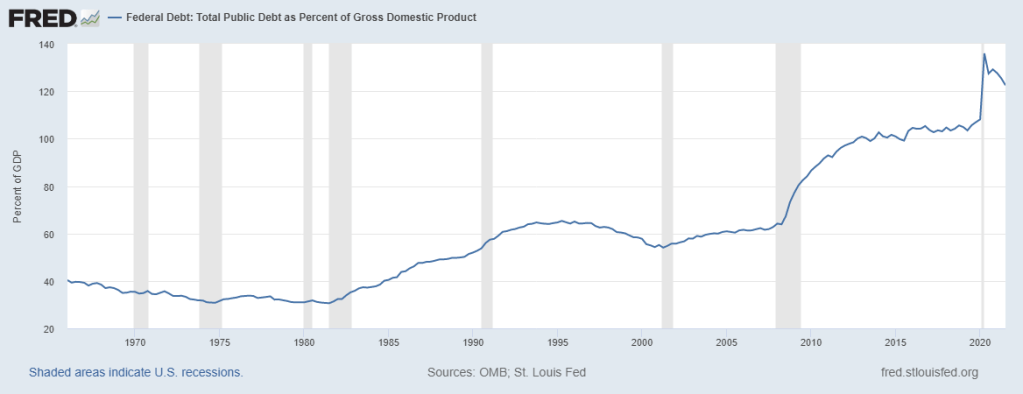
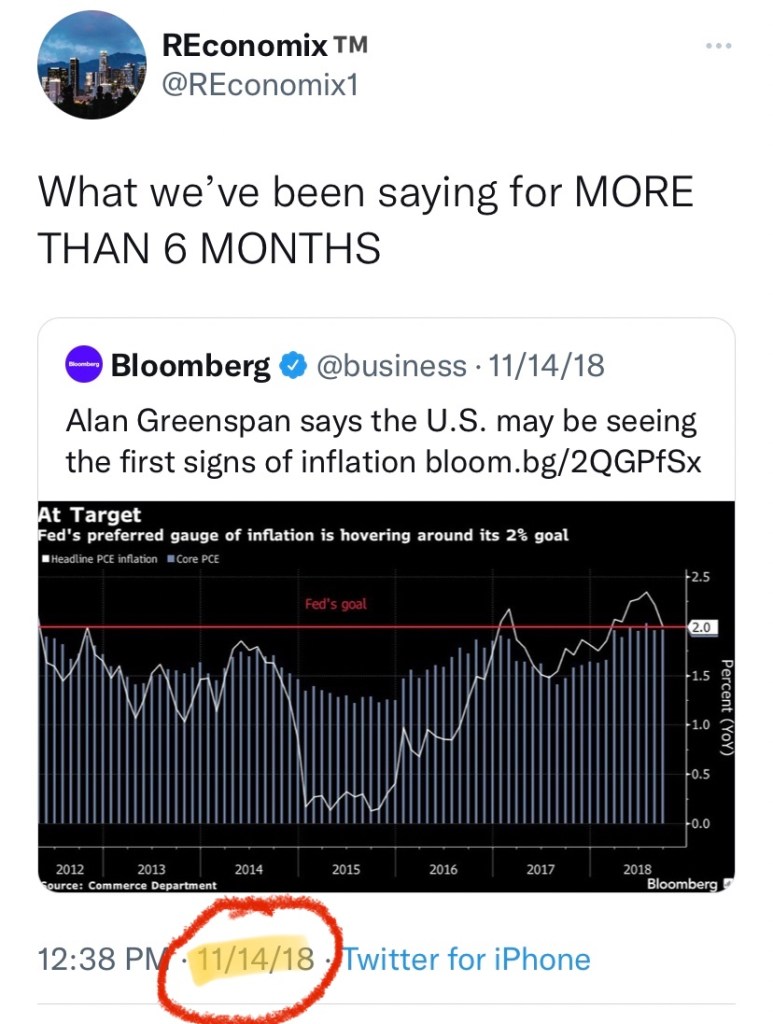
The Elephant in the room– The thing everyone (media, government, wall street big wigs, except for people like Ray Dalio) seem to forget, is that the nation’s DEBT is skyrocketing, and Trump and the GOP just added $5Trillion more of it over the next several years. I warned us all about out-of-control inflation as far back as 2018, and now I’m issuing an even BIGGER warning about our national debt spiral. Our Wall street titans did and said nothing about inflation back then, and they will do and say nothing (except collect tax breaks) about our coming debt explosion. And yet, people wonder why I’m so cynical about the current system.

Not financial advice, but I am currently buying, or interested in…

  • Actual silver coins and bars
  • Actual gold coins and bars
  • BTC
  • Gold/Silver ETF’s
  • Farmland
  • Medical supplies
  • Ammo / guns (if that’s your thing)
  • This is risky- equities – because the markets are stupid, and will likely go even higher before they fall. You must realize that the markets can collapse at any given time. If you go very long, you will likely come out a winner. Don’t panic sell, and you will be ok.
Where do we go from here? Thoughts on tariffs, the economy, Fed, inflation.

Saturday, May 3, 2025

Here, I give a “plain English” explanation and some direction as to where we’re headed economically speaking. After predicting massive inflation, slapping down the “transitory” label that the Fed famously fumbled, predicting numerous small corrections and the Big correction this year, I’ve been on a nonstop win streak since at least 2015. Predicting major macroeconomic moves is part science, art, psychology, and patience, but mostly, you must learn and constantly reinforce your knowledge about what moves markets and economies. There are indicators, some sophisticated, some very simple. There are fiscal and political aspects, monetary aspects, consumer habits, commodity supply and demand, etc. But one of the most important things, is that you must understand these things in relation to one another, their relevance, and have a clear mathematical perspective, so that you know which data to disregard, or apply less “weight” to. Numerous business articles are published each day. Some may be important to certain sectors and industries, but mostly, they are not important to the macro economy.

Speaking of indicators, we have a big group of indicators screaming at us! There is underlying weakness in the economy that the markets haven’t reacted to, because it’s too wrapped up in the 24hr news cycle. But the market psychology of the 24 hr news cycle is a whole topic for another discussion. Here are a few screaming indicators:

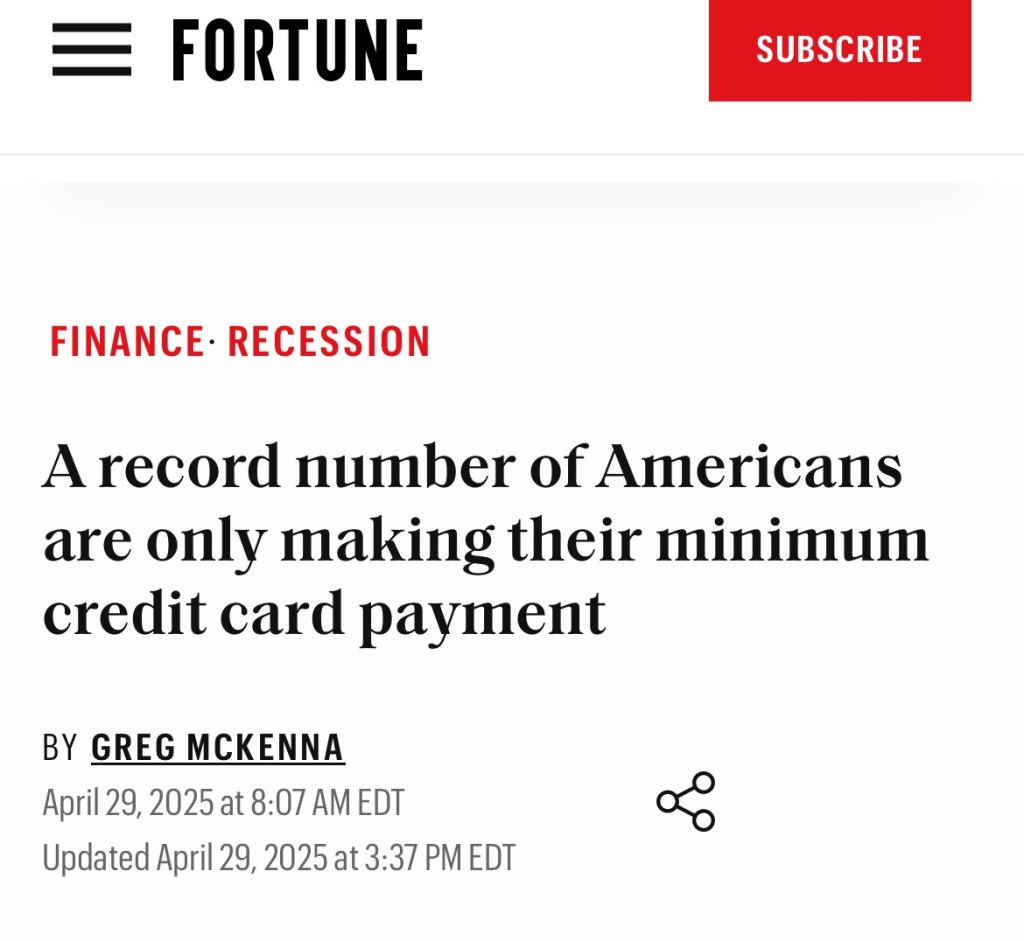
Consumers are not paying down credit card debt, which usually starts to fall after the holiday shopping season.
Credit Card delinquencies are an indicator of financial stress on consumers.
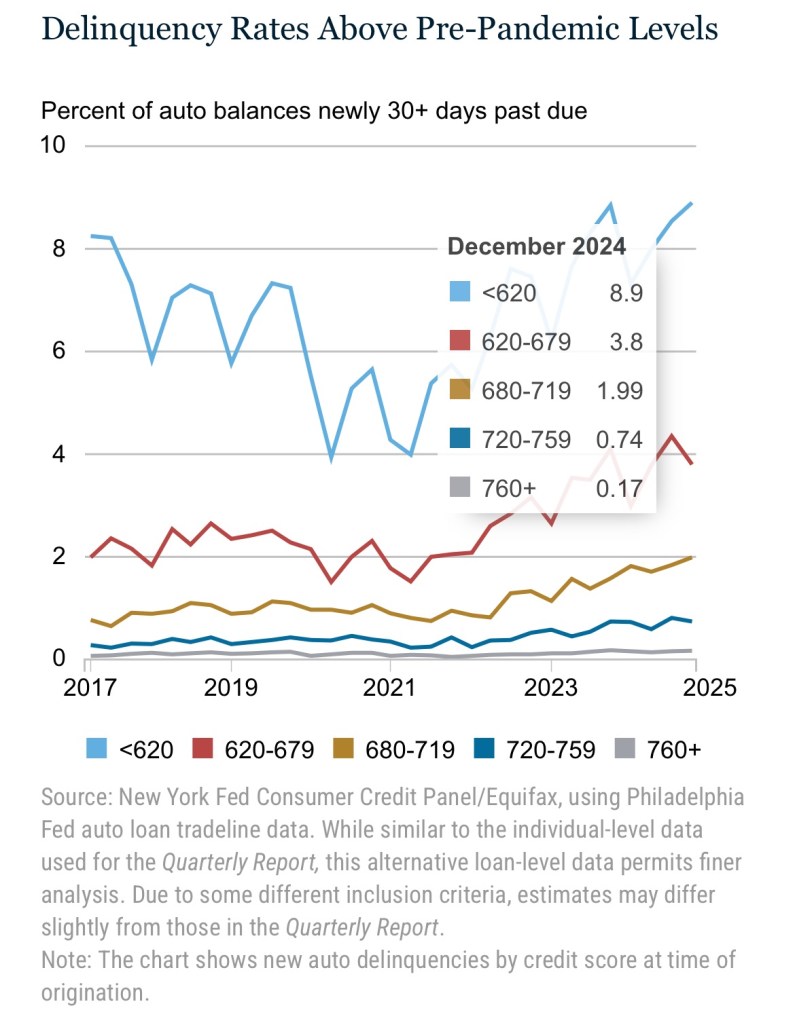
Delinquency rates on auto loans have markedly increased, especially among consumers with subprime credit scores.
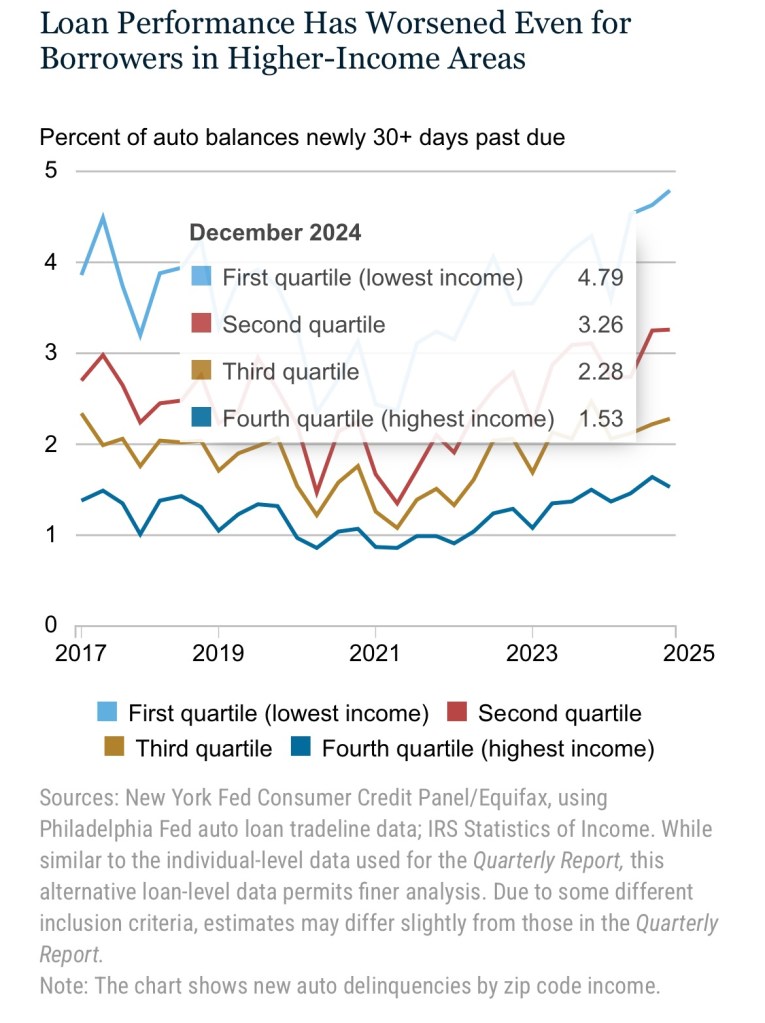
Not all auto loan delinquencies are low-income consumers, a sign that consumer financial distress is widespread.

We also have some major issues at the forefront:

  1. Trade/ Tariff negotiations. These aren’t going as well as hoped by the Trump administration. There will be some “big” (read: amplified) announcements, and they will try to put the best light on them, but the whole thing, short of rolling them back almost completely, is a debacle. It was botched from the beginning, and they will mostly have both short (inflationary) and long (industry altering, layoffs) effects on the economy.
  2. Interest Rates. The most obvious example of the economic illiteracy and ineptitude of the current administration was back in April, when Mr. Trump tried to pressure Fed Chairman Powell into lowering interest rates. The bond market, the true masters of the financial world, slapped him down. Then, he tried to get Powell fired and again, the bond market said no. Time for a quick note on the Fed and its chairman; first, the Fed is run by bankers. Yes, there are economists on the board of governors, but mostly to advise bankers, as they do on Wall Street. Big banks decide who the Fed governors are and who the chairman is. Period. If the Masters of The Universe- people like Jamie Dimon, Larry Fink, Steven Cohen, etc. decide they don’t like the Fed Chairman, rest assured, he will be gone by way of pressure on the stock and bond markets. So, where will interest rates go from here?Well, it depends. There are 2 likely scenarios for the economy right now; the first being near-term volatility, followed by structural stagflation, the 2nd, disinflation, followed by possible deflation.
  3. The most likely near-term scenario is a period of market volatility followed by structural stagflation. This scenario is actually frightening. With the underlying weakness in the economy as a backdrop, oxygen-sucking major economic news dominates the headlines in the form of trade deal announcements, possible interest rate cuts, all fueling markets and creating buzz, and artificial stimulation. Laced in between, are some very bad news reports about layoffs, bankruptcies, and consumer distress. Whether the markets ultimately “shrug off” or react negatively to these reports largely depends on whom people listen to, and this is key. However, the inflationary effects of the tariffs and resulting supply shortages will be giving core inflation a boost. Partly offset by lower energy costs, they will probably get a huge shot in the arm from the new tax bill. Depending on how many short term stimulative gimmicks there are in the final bill, there will be some initial market euphoria as trillions in tax goodies will be handed out. This will be somewhat inflationary. A big reason why Powell is holding back on rate decisions is, he would like to see the final bill first. Why would he risk making a decision that could be muted by the effects of the tax bill? No matter what happens then, he would get the blame.

4. The second most likely near-term scenario is that markets react negatively to the negative economic news, the tariff negotiations fool no one, and massive layoffs start happening very quickly. We’ve already seen Mc Donald’s same-store sales drop off a cliff (a very good indicator), and there’s a lot of other widespread stress signals going on throughout the US economy. This weakness fuels rapid disinflation and possible deflation. The silver lining in this scenario is that Powell then drops interest rates, seeing no real impediments to doing so, and the economy gets another short-to-medium term stimulus effect, as consumers, businesses, and government are allowed to refinance debt at lower interest rates. This is probably the better of both scenarios EXCEPT

The $37 Trillion Elephant in the room is the debt crisis.

5. Through any scenario, the debt crisis has not gone away. DOGE is a dud, and the prospect of massive cuts to social security and Medicare seem less and less likely as Mr. Trump fumbled away tons of political capital with his botched tariff rollout and various political wars he’s waging. This means high budget deficits are here to stay, and regardless of how low the interest rates go, the interest on the debt will be punishing. It will only be a matter of time before bond markets step in again, and start flexing their powerful muscles.

6. Caveats: Supply shocks, wars, pandemics, major disasters can all alter or forestall any of these scenarios. The most powerful evidence of that was the COVID pandemic. A war in the South China Sea or Iran would have major repercussions for markets, economies and political machinations throughout the world, and we must hedge accordingly.

The Sh*t Show is in full swing! (I warned you!)

Written Wednesday Mar 2nd, 2025 10:30PM PDT

Some people are finally getting it. There’s no rhyme or reason to these tariffs. They just don’t make any sense at all. A tariff implemented to bring back shipbuilding to America for instance, would take at least DECADE to actually deliver. BUT it would be worthwhile, helping to bring back an important and strategic US industry.

BUT a tariff (tax) on toasters and pencil sharpeners? Clothes hangers? Men’s underwear? Ask yourself, are these strategic products? What kind of margins are we talking about? Is it even worth it to bring back these jobs? Are these the jobs that will give people the skills of the future? And how much will we have to pay people to do such menial labor, especially at full employment, and while simultaneously cracking down on immigrant labor ??

But also, the argument goes, these tariffs will raise revenue! Let’s put that in perspective. The Trump administration says the tariffs will bring in $600 billion in annual revenue. Even if this is to be believed (and it shouldn’t), The losses in the equity markets from the tariff rollouts have already wiped out $2 Trillion.

And even if that doesn’t jar you, the effects of a recession (now at 50% for 2025 on polymarket, and rising almost weekly in Goldman Sachs estimates) will absolutely wash out those revenue gains.

Vietnam, for instance, exports $150 Billion in goods to the US. If we slap a tariff (TAX on US citizens) on all those goods, and they retaliate with a tariff (TAX on themselves) on our $10 billion of exports to them, who does that really hurt??

So what are the rest of you holding on to? Some insane pipe dream that Trump and his merry band of sycophants are playing 3D chess and intentionally crashing the economy to lower interest rates and bond yields so that he can slay the debt with a combination of inflation and budget cuts???

If that’s the case, let me tell you why you’re wrong. MILLIONS stand to lose their jobs and livelihoods in that scenario. Ever heard of the misery index? This will be the most miserable you’ve ever felt in your lives economically, by far. And, unless you’re sitting on millions of dollars in LIQUID assets, you will absolutely feel it. Because having $1 million, in just a few years, will feel like having $100k.

If you don’t get this concept, there’s little hope for you. You probably will lose your shirt trying to “own the libs” and “win” against your sister in a political debate.

In just a couple years, there will be no more political debate. The party will be officially over. America will turn against this cabal of oligarchs, and they will either capitulate, or try to hold on to power by suppressing and nullifying our votes.

God help us all.

Notes on the economy mini blog – Fear rises

On June 5th 2024, I issued a warning for individuals and investors alike. The data that was coming in signaled a growing weakness in the economy. Check out below.

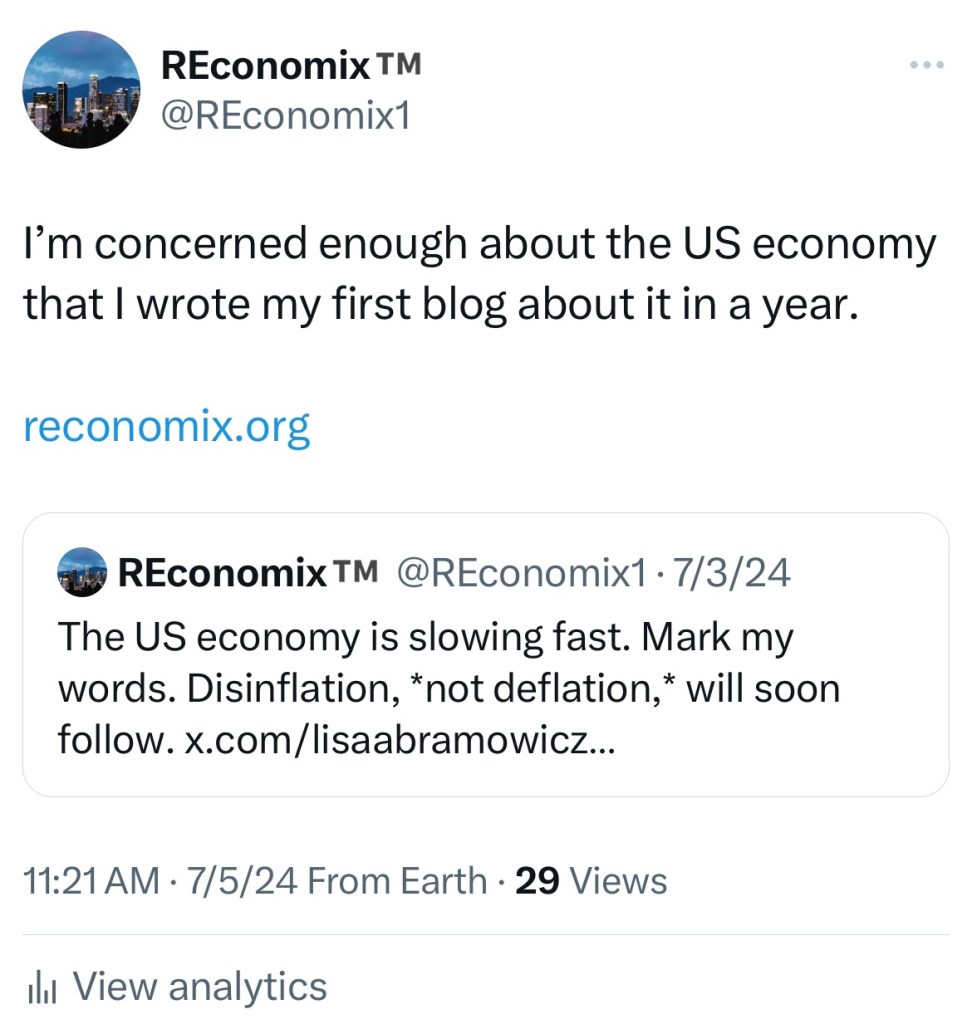
Our warning from July 5th was right on the money!

Today’s data and market reaction has proved me right (yet again!) that the so-called “soft-landing“ may be over. The VIX (CBOE Volatility Index, AKA the “fear index”) is up significantly since our warning.

Just yesterday, the Fed decided to hold rates steady, at least until September. This decision has now come under fire by many as too late to head off recessionary headwinds in the economy. How do I feel about that? Better than a lot of people, because I prepared for it.

A broad market sell-off today signals that investors are at least somewhat nervous about the economy. Bond markets also show signs of broad investor pessimism.

The job market has shown some weakness as well. A slowdown in the monthly hiring rate coupled with rising unemployment is also appearing in the most recent data.

Is it time to panic? Never. Is there hope? Always. Email me about your thoughts and strategies on the current economic condition and how it pertains to you.

Shouting into the void…

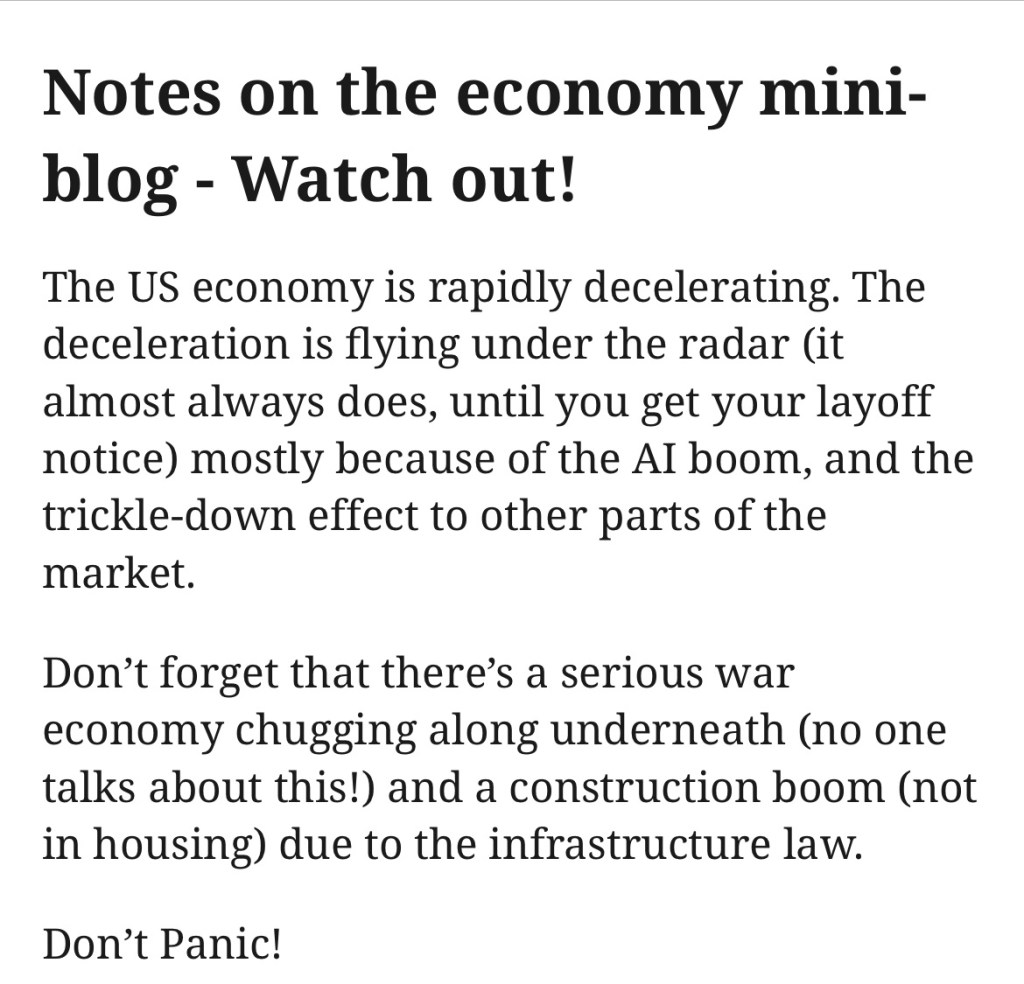
Notes on the economy mini-blog – Watch out!

The US economy is rapidly decelerating. The deceleration is flying under the radar (it almost always does, until you get your layoff notice) mostly because of the AI boom, and the trickle-down effect to other parts of the market.

Don’t forget that there’s a serious war economy chugging along underneath (no one talks about this!) and a construction boom (not in housing) due to the infrastructure law.

Don’t Panic!

Why? The Fed has plenty of ammo due to high interest rates. They can lower interest rates and reaccelerate private investment in a pinch. That’s the short term.

The long-term scenario looks less promising…stick around for more valuable insight, from the person who predicted massive inflation (in 2018!) and laughed when the Fed called it “transitory.”

How does this affect you, on the microeconomic scale? Email me, and stay tuned!!

Notes on the economy mini blog- Irrational exuberance

It’s easy to be a grumpy investor when you’ve missed out on the latest rally, but this is not the case- we actually bought SPY expecting a slight bump. However, what we are seeing is more than a slight bump.

Irrational exuberance is once again rearing it’s ugly head, driven by better than expected employment, an almost sure sign of a resilient economy- if there weren’t so many other flashing red lights.

A pause in rate hiking can actually hurt us by further entrenching inflation (which we predicted as far back as 2018!! Check the receipts). On the other hand- increasing rates can start to unleash a wave of defaults (think commercial real estate) in the already slammed banking sector. The cascading effects can be catastrophic to say the least!

So we’re going to back out of our small SPY position, and wait on the sidelines for a better day. Hopefully, we won’t be waiting too long! #BuyLowSellHigh

The End of the Fed?

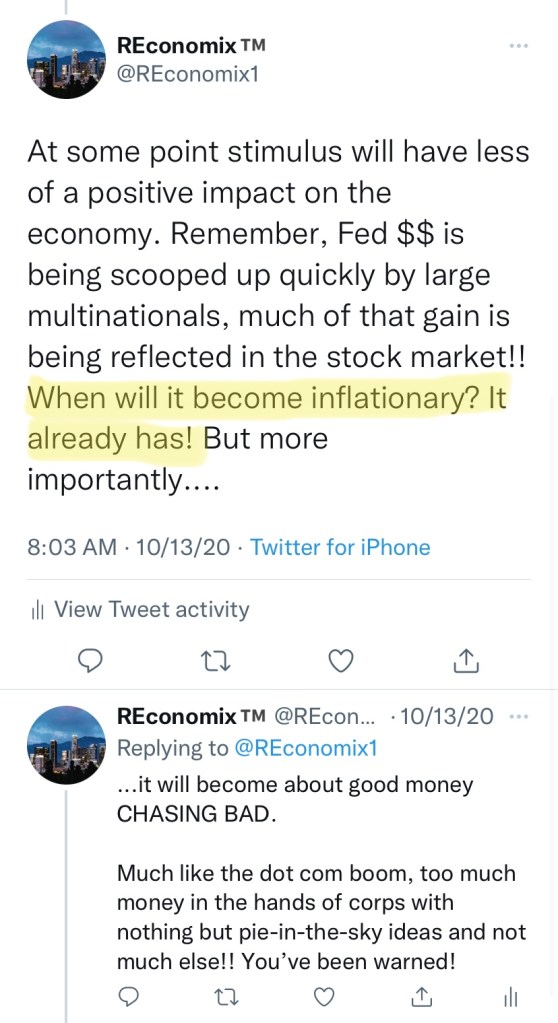
I’ve been predicting higher than expected inflation for years. Then, as soon as Fed chairman Jerome Powell told the world that an unexpected level of “transitory” inflation was here, I told you it wasn’t transitory. Turns out I was right on that one too. So how does one humble student of the global economy and finance beat the consensus of an entire Federal Reserve Board of Governors and their army of researchers ??

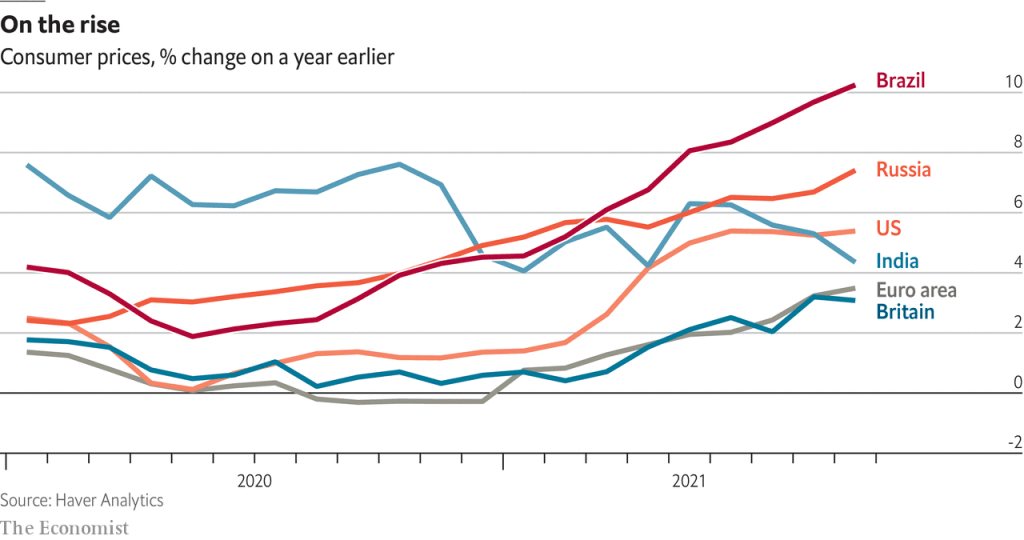
Inflation is not a only a US problem, but a global problem post-pandemic.

For one thing, I live in reality. Also, i’ve been watching the economy, the Fed and government long enough to block out all of the noise. I don’t know what goes on in the minds of the Federal Reserve Board, but I know that most of what we see and hear in the business, finance and economic world is pure noise. Behind nearly every click-bait headline is either a hidden agenda, a skewed worldview, a political axe to grind, or a school of economic thought to defend.

That said, I’m not some wonky, data-mining, hyper-intensive researcher, either. I’m just a guy who has several invaluable assets. Among them, common sense, a comprehensive knowledge of how the global financial system really works, and several tenets I adhere to when dissecting and interpreting data.

US Government fiscal policy, not just Fed policy, is a major driver of inflation.

Now, predictably, the financial and economic world is highly critical of, and scrutinizing every move by the Fed, and will undoubtedly overreact to every announcement. This is foolish. Fed policy isn’t the only game in town. There’s also fiscal policy, consumer behavior and sentiment, and the ever-present threat of game-changing world events (see Covid-19).

These other factors have even more of an impact than the Fed does on the economy at any given time, but it was the decade-long and unprecedented intervention of the Fed coupled with out-of-control fiscal policy that led us to these high levels of inflation. Add in the effects of the pandemic and global supply chain disruptions, and you have a perfect storm for what is happening. Could it have been avoided? Absolutely. But that is for another blog post.

With everyone now second-guessing the Fed (eerily reminiscent of 2008), including former President Trump’s attacks on Jerome Powell in 2019, the tail is now wagging the dog. Wall Street hedge fund manager Bill Ackman rightly tweeted yesterday that the Fed should come out with a large interest rate hike out of the gate. I couldn’t agree more. But with both the Fed and President Biden caught off-guard and leading from behind on this issue, the result is pandemonium. The panicked armchair quarterbacking from across the economic and political spectrum will not cease.

Expect the “independent” Fed to be reigned in

Say hello to new levels of grilling by Senate committee members for their own political posturing. Say hello to political pundits, wall street loudmouths, celebrity billionaires and former heads of so-and-so *cough Larry Summers cough* saying how they would have done it better.

Almost certainly, none of them would have done better than Jerome Powell. This is because the Fed is run by a bunch of bankers. Those bankers know how to make money for only one group of people exceedingly well. Fellow bankers. Although the Fed has a dual mandate, “to promote effectively the goals of maximum employment, stable prices, and moderate long-term interest rates.” they’ve shown a strong inclination toward doing what wall street and the financial/economic elite tell it to do.

After this, those same actors will have an even louder voice and influence on the Fed, ending whatever independence the Fed was supposed to have in the first place. Thus, ending the Fed as we know it for the foreseeable future.

We’ve been warning about inflation for years! Now what?

As usual, my busy life keeps me from posting blogs about the economy, but no more excuses!

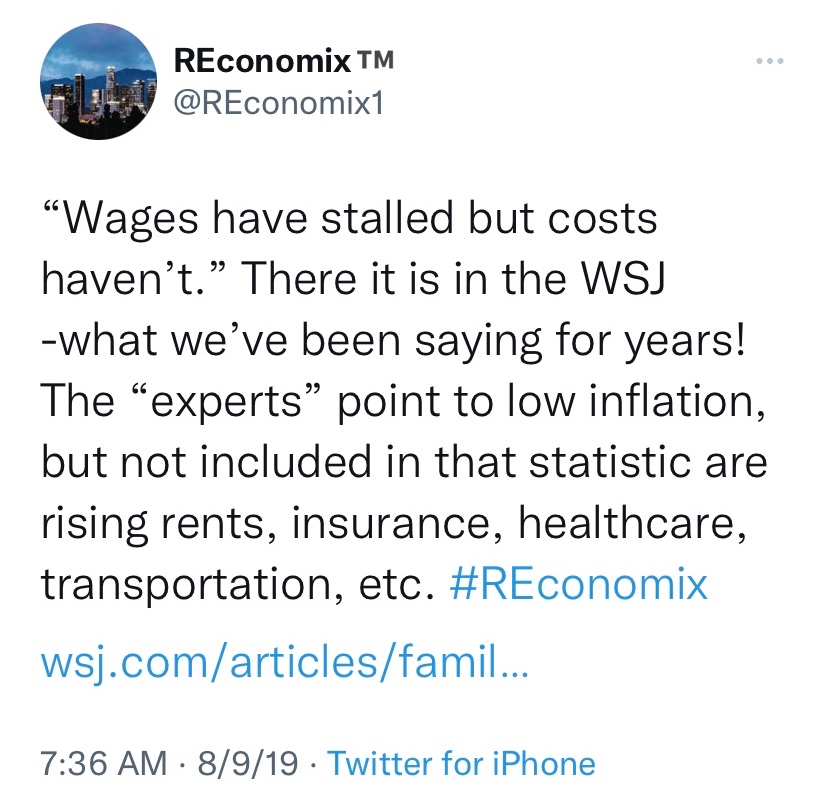
Inflation was being baked-in to the economy well before the pandemic started.

A few of us have been warning people for years about inflation . Not just the occasional tweet of concern, but actually screaming about it via text, and even getting into twitter arguments with people who were absolutely certain that I was wrong.

So ok, now what? Predicting things can be easy sometimes, but what comes next is usually tricky. Not this time. What comes next is entirely predictable.

The first question we must ask ourselves, is whether this inflation is “transitory” as the rudderless Federal Reserve tells us, or whether it’s longer-term, or even, dare I say, structural.

The answer to that is easy for someone like me, because I’ve been watching it build for awhile now. It’s obviously been baked-in to the economy over time- so it is, in fact, long-term.

The Fed has based the monetary policy of the largest economy in the world on a deeply flawed model.

Why isn’t it transitory? That has been ruled out, because many of us who predicted inflation did so well before the pandemic started. The Fed tells us it’s transitory because of a post-pandemic rise in consumerism, and the economy getting back to work. This belies the underlying cause of the inflation itself. The pandemic slowed things to a crawl, and put a temporary hold on inflation. The government, along with the Fed overcompensated (as they often do) and printed trillions of dollars in new cash to break us free from the economic doldrums, and here we are.

Why isn’t it structural? This, because the Fed has lowered interest rates to near zero, the Fed has a lot of medicine to combat inflation. They can also stop printing money. However, it can be bitter medicine, and the delusional Fed has refused to use it, because it would slow down the economy. Slowing down the economy is never a popular idea.

Screaming into the void.

Can inflation become structural? It can, because if the Fed and the US government don’t pull back support quickly, inflation can become runaway train. Inflation breeds inflation, and the worst kind can be programmed psychologically into the consumer. Pulling support from the economy will also have consequences, but it is the bitter medicine we must take.

When a consumer senses something will go up in price if they don’t buy it now, that creates a ripple effect on the economy for necessary goods. This translates into shortages of those goods, and people stop buying unnecessary goods, slowing other parts of the economy and creating a vicious cycle of economic damage and inflation at the same time. This scenario can be down-right frightening.

How can we stop this? Who needs to “step up”? How much time do we have? These topics will be covered in coming blog posts, since this one has gone on a little long.

The US Economy Summer 2021 -It’s up to us.

The United States economy is often compared to an aircraft carrier by experts. It’s massive, and is steered very slowly. Much like an aircraft carrier, it also has millions of moving parts. Some of those parts are human capital, while others are systems and machinery, much like American factories, supply chains, pipelines, and so forth. So when we’re talking about an entire economy in an article or blog post, it’s incredibly easy to leave out thousands of minute details that make the entire machine work.

However, you can take some solace in the fact that much of this giant economy is run by experts.

Yes I said it, but it’s likely not what you think.

Those “experts” are not at the top sometimes, but rather somewhere in the bottom of the ship, running the thousands of moving parts. American workers can extract minerals and resources from the ground, and grow food to feed the population. American engineers can turn those raw materials into useful everyday products, and factories can run the machinery to manufacture those products. American transportation experts and workers can move those goods to retailers, restaurants, grocers, and distribution hubs. American tech companies know how to provide the technology and support for these massive endeavors, and so on.

So, regardless of the Fed moves that are mucking things up, human capital knows how to make adjustments and decisions on the fly, in order to position themselves and their tiny individual sections of the economy for success. We saw this happen all through the pandemic, when millions of families and small businesses made tough decisions everyday in order to survive. Now, with the pandemic at least partially behind us, we must commit ourselves to the hard work of making this giant ship move out of the dire straits we’ve encountered along the way.

WHY CASH IS KING

I’m kicking myself for not posting this yesterday, like I wanted to. Today, with the Dow down around 800 points and NASDAQ down around 600, I may seem like I’m being captain obvious.

However, with the NASDAQ only down 3% and the NASDAQ only down 4.5% off of record highs, I believe that gravity will not let up so easily.

Sure, some Robinhood investors may see this as a chance to catch some stocks on the cheap, but we’re talking fundamentals here! Most of the people on Robinhood don’t know a thing about market fundamentals, and those who do will likely scoff at the very subject.

Back in the year 2000, while I was taking an Information Technology class in college (more specifically -Oracle), I recall one student loudly telling another that his JDS Uniphase stock had nearly doubled to something like $105 per share. The Dot-Com bust spared almost no tech company, including the biggest names in tech at the time.

A year later, JDS Uniphase was clinging to $5 a share. Yes, the stock recovered much later, but the moral of the story is simply keep your powder dry. There will be a chance in the future to make money in the market. Now is not the time. Park your cash in different places, earn that measly percentage rate that your family & friends are joking about, and wait patiently.

INFLATION

One of the main caveats to holding cash is inflation. But with 30 million people out of work, stores and small businesses closing by the thousands, and millions facing eviction, that’s not a worry right now.

Yes, the Fed will likely print more money, but it’s extremely likely that will be eaten up feeding liquidity into a the market in any kind of event like the one we see today. That, my friends, will largely end up in the pockets of a handful of billionaires and opportunistic investors (kinda like us, but with more access) who will be buying real estate, equites and other assets at a very nice discount.