
We’ve been warning about inflation for years! Now what?

As usual, my busy life keeps me from posting blogs about the economy, but no more excuses!
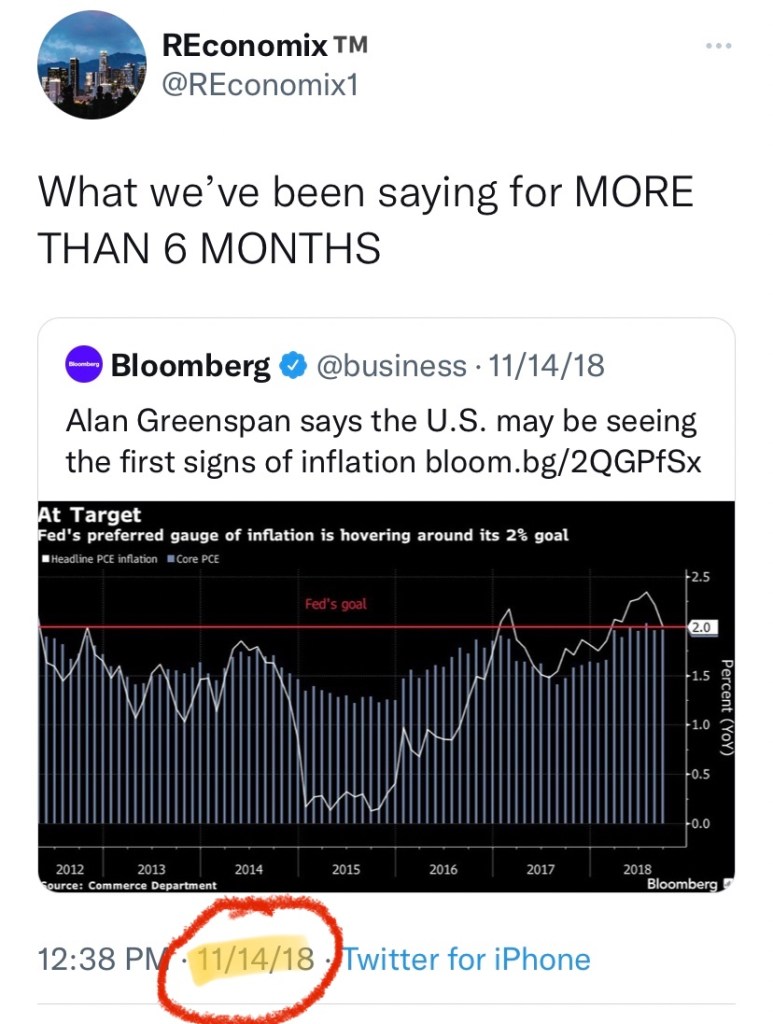
Inflation was being baked-in to the economy well before the pandemic started.

A few of us have been warning people for years about inflation . Not just the occasional tweet of concern, but actually screaming about it via text, and even getting into twitter arguments with people who were absolutely certain that I was wrong.

So ok, now what? Predicting things can be easy sometimes, but what comes next is usually tricky. Not this time. What comes next is entirely predictable.

The first question we must ask ourselves, is whether this inflation is “transitory” as the rudderless Federal Reserve tells us, or whether it’s longer-term, or even, dare I say, structural.

The answer to that is easy for someone like me, because I’ve been watching it build for awhile now. It’s obviously been baked-in to the economy over time- so it is, in fact, long-term.
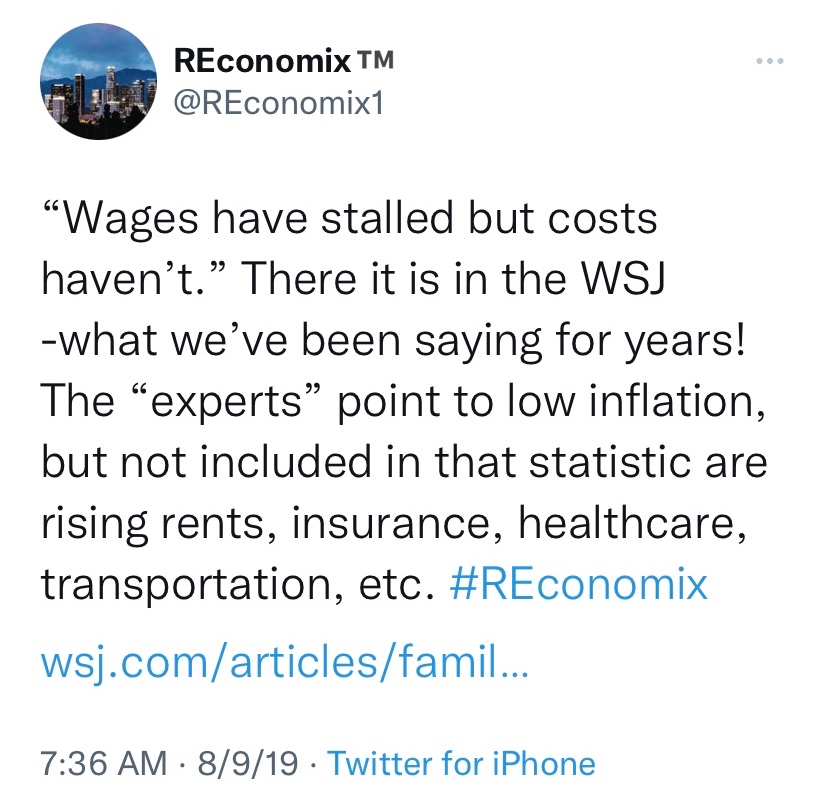
The Fed has based the monetary policy of the largest economy in the world on a deeply flawed model.

Why isn’t it transitory? That has been ruled out, because many of us who predicted inflation did so well before the pandemic started. The Fed tells us it’s transitory because of a post-pandemic rise in consumerism, and the economy getting back to work. This belies the underlying cause of the inflation itself. The pandemic slowed things to a crawl, and put a temporary hold on inflation. The government, along with the Fed overcompensated (as they often do) and printed trillions of dollars in new cash to break us free from the economic doldrums, and here we are.

Why isn’t it structural? This, because the Fed has lowered interest rates to near zero, the Fed has a lot of medicine to combat inflation. They can also stop printing money. However, it can be bitter medicine, and the delusional Fed has refused to use it, because it would slow down the economy. Slowing down the economy is never a popular idea.
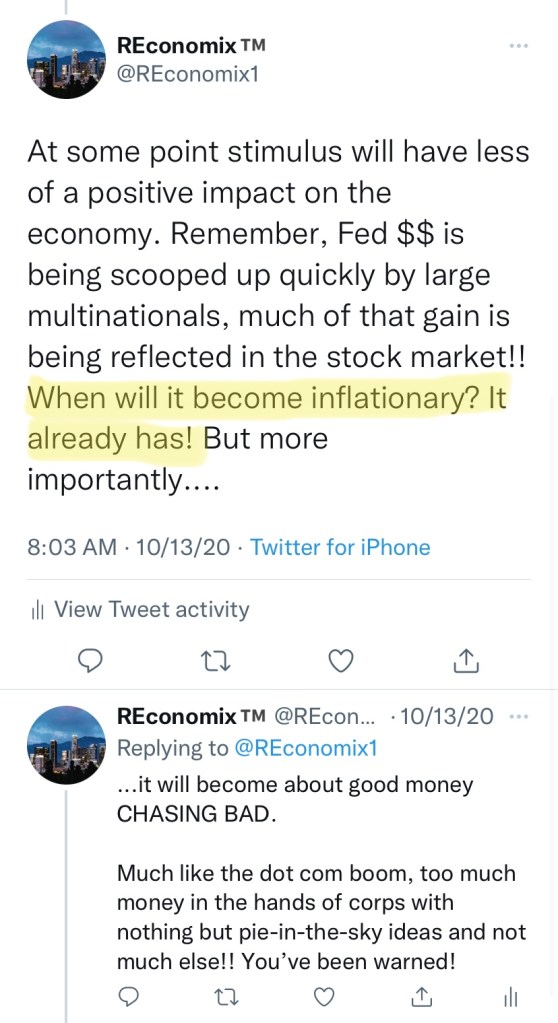
Screaming into the void.

Can inflation become structural? It can, because if the Fed and the US government don’t pull back support quickly, inflation can become runaway train. Inflation breeds inflation, and the worst kind can be programmed psychologically into the consumer. Pulling support from the economy will also have consequences, but it is the bitter medicine we must take.

When a consumer senses something will go up in price if they don’t buy it now, that creates a ripple effect on the economy for necessary goods. This translates into shortages of those goods, and people stop buying unnecessary goods, slowing other parts of the economy and creating a vicious cycle of economic damage and inflation at the same time. This scenario can be down-right frightening.

How can we stop this? Who needs to “step up”? How much time do we have? These topics will be covered in coming blog posts, since this one has gone on a little long.

The US Economy Summer 2021 -It’s up to us.

The United States economy is often compared to an aircraft carrier by experts. It’s massive, and is steered very slowly. Much like an aircraft carrier, it also has millions of moving parts. Some of those parts are human capital, while others are systems and machinery, much like American factories, supply chains, pipelines, and so forth. So when we’re talking about an entire economy in an article or blog post, it’s incredibly easy to leave out thousands of minute details that make the entire machine work.

However, you can take some solace in the fact that much of this giant economy is run by experts.

Yes I said it, but it’s likely not what you think.

Those “experts” are not at the top sometimes, but rather somewhere in the bottom of the ship, running the thousands of moving parts. American workers can extract minerals and resources from the ground, and grow food to feed the population. American engineers can turn those raw materials into useful everyday products, and factories can run the machinery to manufacture those products. American transportation experts and workers can move those goods to retailers, restaurants, grocers, and distribution hubs. American tech companies know how to provide the technology and support for these massive endeavors, and so on.

So, regardless of the Fed moves that are mucking things up, human capital knows how to make adjustments and decisions on the fly, in order to position themselves and their tiny individual sections of the economy for success. We saw this happen all through the pandemic, when millions of families and small businesses made tough decisions everyday in order to survive. Now, with the pandemic at least partially behind us, we must commit ourselves to the hard work of making this giant ship move out of the dire straits we’ve encountered along the way.

WHY CASH IS KING

I’m kicking myself for not posting this yesterday, like I wanted to. Today, with the Dow down around 800 points and NASDAQ down around 600, I may seem like I’m being captain obvious.

However, with the NASDAQ only down 3% and the NASDAQ only down 4.5% off of record highs, I believe that gravity will not let up so easily.

Sure, some Robinhood investors may see this as a chance to catch some stocks on the cheap, but we’re talking fundamentals here! Most of the people on Robinhood don’t know a thing about market fundamentals, and those who do will likely scoff at the very subject.

Back in the year 2000, while I was taking an Information Technology class in college (more specifically -Oracle), I recall one student loudly telling another that his JDS Uniphase stock had nearly doubled to something like $105 per share. The Dot-Com bust spared almost no tech company, including the biggest names in tech at the time.

A year later, JDS Uniphase was clinging to $5 a share. Yes, the stock recovered much later, but the moral of the story is simply keep your powder dry. There will be a chance in the future to make money in the market. Now is not the time. Park your cash in different places, earn that measly percentage rate that your family & friends are joking about, and wait patiently.

INFLATION

One of the main caveats to holding cash is inflation. But with 30 million people out of work, stores and small businesses closing by the thousands, and millions facing eviction, that’s not a worry right now.

Yes, the Fed will likely print more money, but it’s extremely likely that will be eaten up feeding liquidity into a the market in any kind of event like the one we see today. That, my friends, will largely end up in the pockets of a handful of billionaires and opportunistic investors (kinda like us, but with more access) who will be buying real estate, equites and other assets at a very nice discount.

REconomix™️ Economic Survival Mini-blog; What Do I Do now? (short-term) Pt. 3

An article recently stated that many people are googling “should I buy a house?” They are concerned about the economic impacts of COVID-19 but want to take advantage of historically low interest rates.

Buying a house is a very long-term decision. Although we have no idea how long this pandemic will be with us, note that past pandemics have been relatively short-lived.

If you are financially stable, can afford it, don’t fear a loss of your job, and you see a good opportunity, take it. You will look back on it many years later as a wise decision. But don’t just buy a given property based on low interest rates. Rates will likely stay low for the foreseeable future.

Don’t try to time the market either. If you believe sales may tank and housing prices will go down, you may want to wait, but remember, housing supply is still low, so when demand eventually does come back, housing prices will go up with it. Moreover, If the pandemic ends relatively soon, you could see most prices stay right where they’re at.

REconomix™️ Economic Survival Mini-blog; What Do I Do now? (short-term) Pt. 2

Several people have asked me if they should liquidate their 401k. The short answer is no, wait things out. I will discuss this in more detail in a later post. Don’t forget there are taxes, and also penalties for pulling funds too early.

That said, if you are really business savvy you can invest the funds in real estate or even purchase a small business that has good financials and a proven track record. Both can be very risky, please do your research and don’t take anyone’s word for it, make sure a licensed CPA certifies the company’s financial statements before buying, and use an escrow account. Please consult with licensed experts such as a contract attorney before signing any paperwork!

REconomix™️ Economic Survival Mini-blog; What Do I Do now? (short-term)

Quietly and calmly go to your nearest bank or credit union and pull some extra cash out. The banking system took a huge hit today and it took a $1 Trillion injection of cash in order to shore it up. It kept markets running, but didn’t help investor confidence. Another big hit, and markets can panic even worse, making these injections useless. Banks may have short-term liquidity problems, meaning that they won’t have enough cash on hand in an event that people start running to their banks to pull out cash. At that point, even ATM card readers may be unable to process transactions in some instances, and CASH WILL BE KING , especially when you need it for food, water or an emergency.

2018 Year in Review-Stock Markets/Economy – How my predictions were spot-on

2018 Year in review – Stock Markets by Paul D. Antuna 

With the S&P 500 and the DJIA back to where they were nearly one year ago, the stock market is looking more and more credible by the week. Corporate valuations have almost returned back to Earth. I knew stocks were overvalued, since before the last stock market correction, which ended up being largely forgotten by late spring.


Stock Prediction 2-2018
My warning about the last stock market correction, which was largely forgotten by late spring.


It turns out that the summer rally in the stock market was never really called for. In addition, mainstream economists are now saying what we’ve been saying for many months -that rosy economic indicators are pointing downward. We’re not talking about recession yet, but rather a period of economic slow-growth.

Stock Prediction 8-2018
By late summer, US stock markets were really overcooked.

Actually, I’ve been warning about the over-valued stock markets for a little over a year now, as the specter of rising interest rates is just now being realized. I correctly predicted that interest rates would rise, which was in line with consensus predictions by most mainstream economists, as the Fed’s tightening continued. It’s not just interest rates that are affecting the markets, however. The skyrocketing amount of corporate debt (somewhere between $6-9 trillion USD,  -exacerbated further by rising interest rates), and the wearing-off of one-time charge-offs due to tax changes are at play. Separately, trade implications from rising tariffs are starting to ripple through the markets.

Stock Prediction 9-2017.jpg
And buying low we are- but only long-term growth prospects and corporations with healthy balance sheets. 

With regard to corporate debt, we have seen unprecedented levels of it, mostly caused by the extended period of low interest rates, a favorable tax climate, and quite a bit of over-confidence.

Charge-offs allowed in the recent tax code changes allowed for huge increases in capital expenditures 

Some good news in all of this is that this type of correction is actually healthy for markets. What we’ve become accustomed to in the last 5 years or so are piles of money going to nearly all sectors of the market without much reservation. What we have now is careful, or “smart” investors reevaluating companies based on their individual merits rather that some pervasive feel-good emotion that everything’s just going up up up.

How did I know the correction was coming?

  1. I knew because we’ve studied the debt cycle over and over and we determined that we’re in the end stages of the current debt cycle. Here’s an excellent video about that here.
  2. Because the way the trump tax law was written , there are both short and long term implications, and the short-term juicing of the economy caused a sugar high that was bound to wear off.
  3. Because the market had not yet priced-in the effects of rising interest rates, which although are historically still low, take a significant bite out of earnings statements when combined corporate debt in the trillions.
  4. Tariffs have affected businesses in ways that are just starting to play out- and will continue to play out- well into the future.
  5. Because smart money exited the market just before the recent correction.
  6. Because I have other analytical tools that I would love to teach you about! Please come back and visit this blog regularly, as more frequent updates are coming. Also follow me on twitter @REconomix1 for the latest warnings, recommendations and articles of interest.

You can reach me at REconomix1@gmail.com for any questions, comments, concerns.